Google’s dominance of the advertising world has come to an end. For the first time since digital advertising as we know it came into existence, Meta is set to overtake Google in global advertising revenue by 2026, according to forecasts published by eMarketer. It’s not just a headline: it’s a paradigm shift that directly affects how any advertiser, from a Barcelona-based SME to a multinational, should allocate their budget this year.
At Vandelay, we’ve been observing this shift in our clients’ accounts for months. Spending on Meta was rising, whilst Google’s cost-per-click was increasing without a commensurate return. What appeared to be a trend is now confirmed by the figures. Let’s see what the data tells us, why this is happening and, above all, what you should adjust in your digital advertising strategy before the end of the quarter.
The figures behind the sorpasso
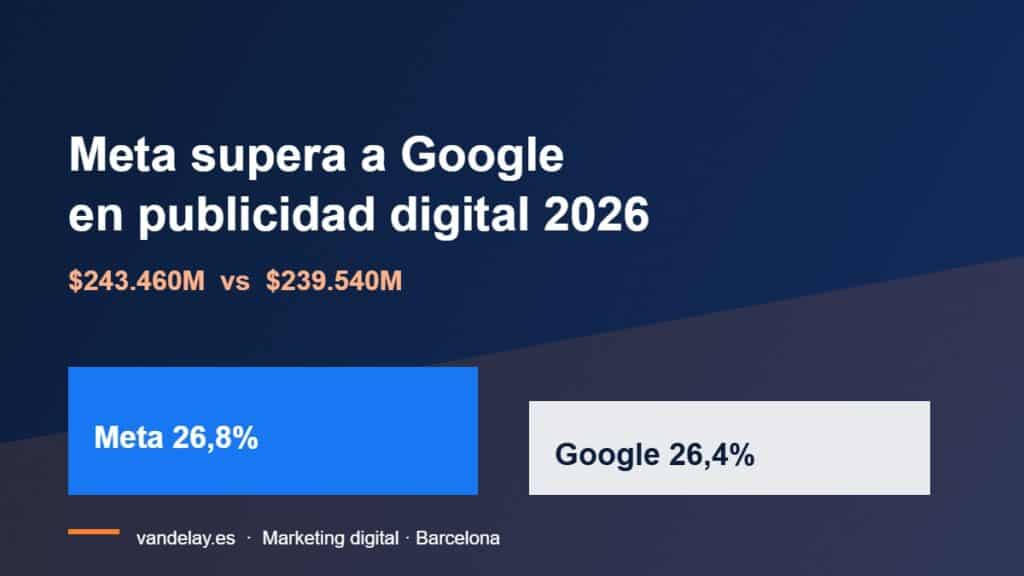
eMarketer estimates that Meta is set to generate $243.46 billion in global advertising revenue by 2026, compared with Google’s 239.54 billion. It is a small margin, yes, but the key figure is not the absolute difference, but the trend. Meta is growing at 24.1 1Q3Q annual, whilst Google remains at 11,9 %. At that rate, by 2027 the gap will be visible even without a magnifying glass.
In terms of market share, Meta will come to control 26.8% of global digital advertising spend in Q1, ahead of Google’s 26.4% Q3 2023 figure. If we include Amazon, the Meta–Google–Amazon trio will account for 62.3% of global digital advertising spend in Q1 in 2026, compared with 59.9% in Q1 of the previous year. Concentration is intensifying, and small advertisers have less and less room for manoeuvre.
Why is Meta growing so fast?
It’s not magic. There are three key factors that explain this surge, and it’s worth understanding them because they determine how an account is managed today.
1. Advantage+ and AI-driven automation
Advantage+ Shopping campaigns are responsible for much of the growth. According to figures shared by Meta, Advantage+ campaigns are delivering a ROAS up 22% year-on-year compared to those managed manually. The data also suggests that the 82% of Meta advertisers are already using some form of Advantage+ automation and that more than four million accounts are now using its generative AI tools, compared with the one million that were using them six months earlier. Adoption has accelerated at an unprecedented rate.
2. New advertising spaces on WhatsApp and Threads
WhatsApp Business and Threads have opened up additional inventory. For years, WhatsApp had been a huge asset within the group without generating significant advertising revenue; now it is starting to contribute. Threads, although smaller, adds touchpoints without cannibalising Instagram. More inventory means more available impressions and, in many cases, lower CPMs during the adoption phase.
3. AI-powered creativity within Ads Manager
Meta has invested heavily in tools that allow users to generate and scale creative variations directly within Ads Manager. For the average advertiser, this translates into something very specific: the ability to test more angles without needing a production team behind them. The creative barrier, which for years held SMEs back, has been significantly lowered.
And in the meantime, what’s happening at Google?
Google is still a giant: $239.54 billion isn’t generated by chance. But the situation has become more complicated for the company. AI Overviews and AI Mode have reduced the number of clicks to publishers and advertisers: public data suggests that approximately 60% of Google searches are now zero-click, in other words, they are completed without the user leaving the SERP. That’s great for Google as a product, but it undermines the traditional advertising model based on clicks to external pages.
Added to this is the migration of DSA campaigns to AI Max for Search, scheduled for September 2026 according to Google’s official calendar. It is a structural change that will require the reconfiguration of thousands of accounts worldwide and which, for now, is raising more questions than providing answers among the advertisers we speak to every week.
What you should do in your account from today
This is where the news stops being just a headline and becomes a budgetary decision. These are the guidelines we’re applying with our clients at Vandelay, tailored to each business’s profile.
Take a hard look at the Meta/Google split
If you’ve been sticking with a 60/40 split in Google’s favour for the past three years simply because “it’s always worked”, the data is telling you it’s time to have a chat. It’s not about moving everything to Meta — context matters, and there are sectors where Google remains unbeatable: high intent, local searches, highly technical B2B — but rather about recalculate the allocation using the actual CPAs for the last 90 days, not last year's.
Try Advantage+ Shopping
The entry threshold has been simplified and you’ll pick things up quickly. Start with a small percentage of your budget, let the algorithm run for at least two weeks, and then compare the results with your manual campaigns using the data at hand. Important: start measuring from GA4 or a mix of attribution models, not just from a pixel-by-pixel perspective.
Don’t give up on SEO, but adjust your expectations
With 60% of searches now being zero-click, traditional SEO focused purely on clicks is being called into question. What continues to work is SEO aimed at securing citations within generative responses (what some call GEO o AEO), search engine branding and content that can be referenced by models such as Gemini, ChatGPT or Perplexity.
Use WhatsApp Business as an advertising channel
Our tests in e-commerce and professional services have shown response rates far higher than those for email, particularly in sectors where pre-sale conversations are commonplace. Treat it as a channel with its own sales funnel, not just as a customer service inbox.
Keep an eye on the features, particularly cross-platform ones
When Meta gains ground and Google is no longer the last click in many cases, the picture changes. If your attribution model continues to give all the credit to the last click on Google, you’re underestimating the contribution of the rest of the funnel.
A note on what the headlines don’t say
There is one detail that few press releases have picked up on: that Meta has overtaken Google doesn't mean that Meta is “better” for your business. Each platform serves a different purpose. Google continues to capture existing demand; Meta generates new demand. Confusing the two is a sure-fire way to waste money. The metric that matters isn’t eMarketer’s global market share, but the actual cost per customer you’re paying on each channel today, this week, on your account.
What the sorpasso does change is the directed conversation: From now on, it’s harder to justify the claim that “we always invest more in Google”. And that, paradoxically, is good news for any small or medium-sized brand that has the data at its fingertips and is willing to analyse it without bias.
If you’d like to see how your budget is allocated across Meta Ads, Google Ads and other channels, at Vandelay we carry out advertising account audits in under a week, providing cross-referenced data and actionable recommendations. Write to us and we’ll tell you, with no strings attached, where the money you’re missing out on is.
 English (UK)
  Español