For years, video was the expensive part of digital marketing: filming, editing, reviewing, repeating. For an SME on a tight budget, competing on YouTube with a decent advert seemed like something only big brands could do. That’s exactly what View on Google Ads Things are about to change. Google has integrated its generative video model into its advertising platform itself, so you can now turn a product photo into a video ready for publication without leaving your account or hiring a production company.
At Vandelay, we’ve been testing it for weeks on real client accounts in Barcelona, and our preliminary verdict is twofold: it’s a tool that genuinely saves time, but it’s no magic bullet. We’re going to explain what it is, how it works and — this is what almost nobody tells you — when no You should use it exactly as it is.
What is Veo in Google Ads (and what’s Asset Studio got to do with it?)
Veo is Google’s AI-powered video generation model. What has changed in 2026 is where vive: it’s no longer just a separate app, but is now part of Asset Studio, the Google Ads platform for creating creative assets. As reported by Search Engine Land (27 March 2026), Google rolled out Veo globally within Google Ads, enabling any advertiser to create short videos directly from the campaign interface.
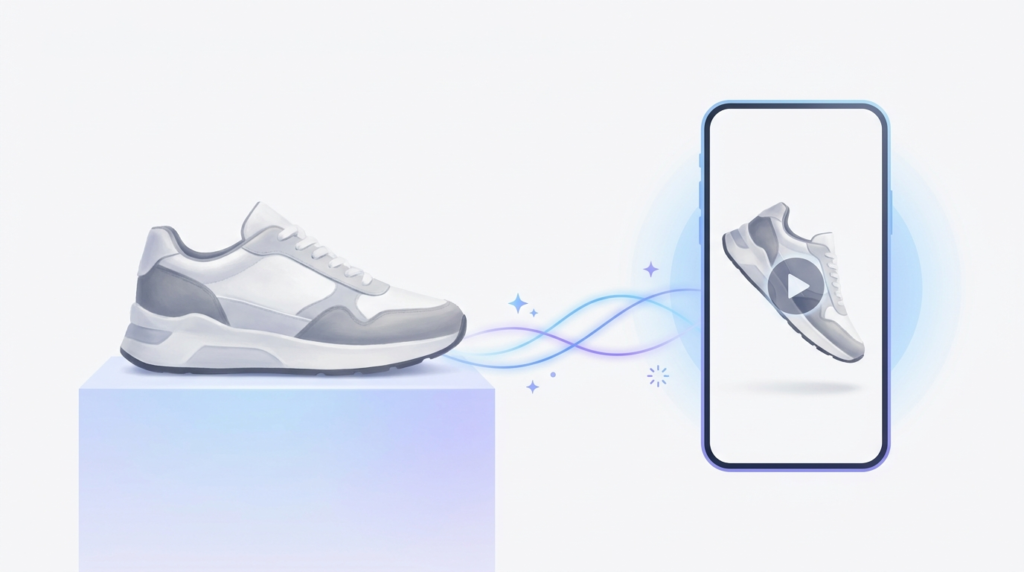
In practice: you upload up to three static images and Veo generates videos of up to 10 seconds with natural motion, designed for YouTube’s formats and audiences. These clips can then be converted into adverts ready for delivery using customisable templates. This is an evolution of the previous rollout of video templates and automatic video creation in Demand Gen campaigns, according to the same source.
How it works, step by step
The process, as documented and as we have seen in the accounts, is straightforward:
- Go to Asset Studio within your Google Ads account, in the creative assets section.
- Upload up to three images. Product photos that are clean, well-lit and have a neutral background tend to work best. Veo creates a video for each image, so you can end up with up to three different versions from a single shoot.
- Describe the scene What you’re looking for: the type of movement, the style, the atmosphere. The more specific you are, the less of a gamble it’ll be.
- Generate and review. You get video clips of up to 10 seconds featuring motion, ready for YouTube and for Search, Display or Performance Max campaigns.
- Adjust using templates. Google allows you to combine Veo with Nano Banana to customise ad creatives: change backgrounds, adjust the message or tailor the content to the audience’s specific interests, according to Search Engine Land.
One detail that is by no means insignificant: the performance is being staged at no extra cost for advertisers. There is no waiting list or limited beta; it is available in Google Ads accounts. This is in line with the approach Google has been taking since Google Marketing Live 2026: integrate AI into the advertiser’s workflow so that creative production is no longer a bottleneck.
What really changes for an SME?
The reason why this matters is simple: on YouTube, video consistently performs better than static content, but producing it has always required time, a budget and expertise, as he points out Search Engine Land. I can see that barrier coming down. If you have a catalogue of product photos — and almost any shop or local business does — you can now venture into video formats where you wouldn’t even have considered competing before.
For us, the most interesting change isn’t “making a nice video”, but rather be able to test much more. In the past, testing five different versions of a video advert was unthinkable for an SME due to the cost. Now you can create several versions, launch them, see which one converts best and stick with the winner. Creativity is no longer a one-off gamble but becomes an iterative process – which is exactly how performance-based advertising should work.
It also changes the division of tasks within the team. What used to hold a campaign up whilst waiting for a design or a production company can now be kicked off by the very person who manages the accounts. It doesn’t do away with the creative team — we’ll see that in a moment — but it does free up the first few hours of routine work.
The limitations nobody tells you about in the headline
We need to be honest here, because proper marketing is based on sound judgement, not just enthusiasm. Ten seconds of AI-generated video does not constitute a campaign. These are the precautions we take:
- Mandatory human review. AI sometimes “makes up” details: a seam that isn’t there, a strange reflection, an unnatural movement in the product. In categories where accuracy matters (fashion, food, jewellery), a poorly generated clip can convey exactly the opposite of what you want.
- The brand is still yours. Style, tone and message don’t just emerge from the template on their own. If you don’t provide direction, you’ll end up with a generic video that looks just like your competitors’. The brief is still key.
- Transparency and regulations. From 2 August 2026, under the EU AI Act, there are transparency requirements regarding content generated or manipulated using AI. It is worth bearing this in mind before rolling out this type of creative work.
- You’re still the one in charge. As we explained earlier when analysing the new Google Ads terms, the fact that the advert is generated by AI does not shift the responsibility to Google: it remains with the advertiser. Please check what you publish.
How we’re using it at Vandelay
Our approach is not simply to “generate for the sake of generating”. We use Veo as a catalyst within a process where important decisions are still made by human judgement. Specifically: we always start with real, well-lit product photos (input quality determines output quality), generate several variants with different messaging angles, ruthlessly discard those with strange artefacts, and only then set up the test campaign. Metrics are key: if an AI-generated clip doesn’t convert better than the creative we already had, it doesn’t make the cut.
This line of reasoning is consistent with what we have been arguing regarding the short-form video and its ROI: AI doesn’t replace strategy; it makes it cheaper to implement. And for an SME, that is precisely what opens the door to channels that were previously reserved for those who could afford a production company.
Frequently Asked Questions about Veo on Google Ads
How much does it cost to use Veo on Google Ads?
Video creation using Veo within Asset Studio is provided at no extra cost to the advertiser; as always, you pay for the campaign’s advertising spend, not for creating the advert.
How many images can I use, and how long is the video?
You can upload up to three still images, and Veo generates videos of up to 10 seconds with natural motion, designed for YouTube formats, according to Search Engine Land.
In which campaigns can I use these videos?
The clips are designed for YouTube and are suitable for campaigns where video plays a key role, such as Demand Gen and Performance Max. Once integrated into Asset Studio, they become available as creative assets within your account.
Is it safe for my brand?
This is the case if you retain human oversight. AI speeds up production, but the advertiser remains responsible for the content published and must comply with the transparency obligations under the EU AI Act where applicable.
If you’ve got a catalogue of photos sitting in a folder, now’s a good time to give it a go. Pick three products, create a couple of variations of each, and run them as a test against your current creatives. Within a week, the data will tell you whether Veo has a place in your account. And if you’d prefer us to guide you through that first test — from image selection to measurement — at Vandelay we’re already doing this with clients in Barcelona: drop us a line and we’ll set it up with you.
Sources
- Anu Adegbola, “Google is rolling out its Veo video generation model to Google Ads worldwide”, Search Engine Land, 27 March 2026.
- Regulation (EU) 2024/1689 (EU AI Act): transparency obligations under Article 50, applicable from 2 August 2026.
 English (UK)
  Español