
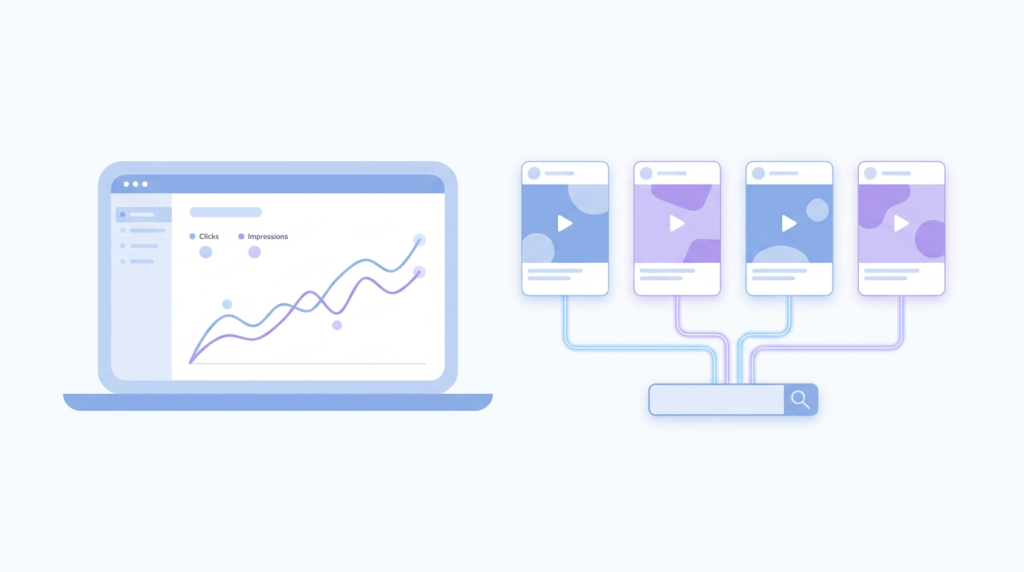
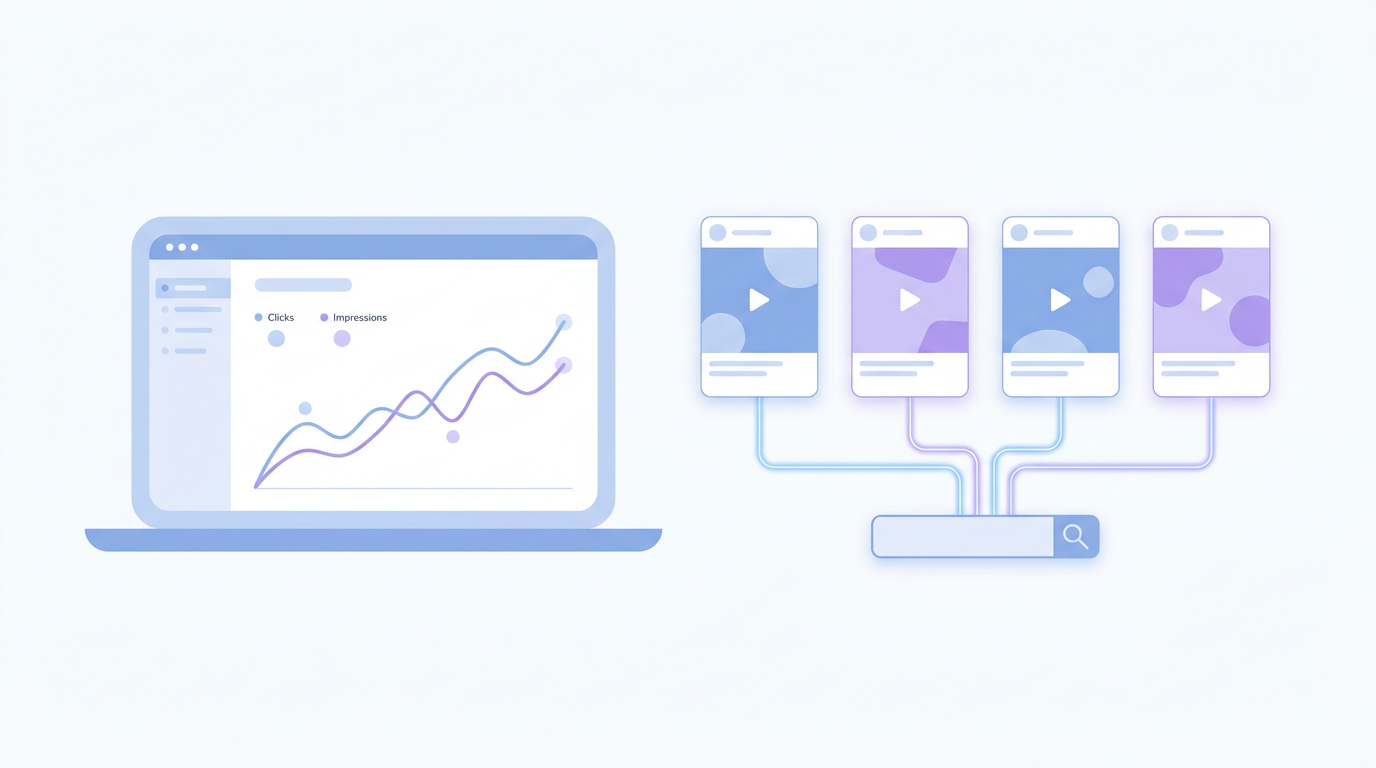
There’s one question that comes up at almost every results meeting and which, until now, didn’t have a clear answer: «Does my Instagram or TikTok content drive traffic from Google?» We suspected it did. Profiles and videos appear in search results, in carousels and on Discover. But measuring this was impossible, because Instagram Insights only tells you what’s happening within Instagram, whilst Search Console only provided data for your domain.
On 7 July 2026, Google closed that gap. The platform properties in Search Console They are a new type of feature that allows you to check and analyse Instagram, TikTok, X and YouTube profiles, and see which searches lead to that content within Google Search and Discover.
The short answer, for those in a hurry: you can add your social media profile as a property in Search Console, verify it via an on-screen authorisation, and view clicks, impressions and queries for your social media posts in the Performance, Statistics and Achievements reports. The roll-out is taking place gradually.
What exactly are platform properties in Search Console?
Until now, Search Console had two types of property: domain and URL prefix. Both required something obvious: that you were the technical owner of the site. You could prove this with a DNS record, an HTML file or a tag in the code.
Platform features defy that logic. Google explained it as follows on its developer blog:
«We’re excited to introduce platform properties, a new type of property in Search Console designed to help site owners and creators understand how their social and video posts perform in Google Search and Discover.»
In practical terms: you no longer need to access the instagram.com server to view search data for your Instagram profile. You verify that the account is yours by authorising the connection via the platform itself, and Google then returns the performance metrics for that content in its search engine.
The four platforms supported at launch are Instagram, TikTok, X and YouTube. Google has not announced, in the documentation we have consulted, when or if this will be extended to other networks.
What reports are included?
According to the official documentation, the data relating to a platform property is divided across three locations:
- Performance Report. Total clicks, impressions and related metrics. You can filter and sort the data to see which posts and specific search queries generate the most traffic, and export the data if you’d prefer to analyse it in another tool.
- Statistics Report (Insights). An overview: recent traffic trends, top-performing posts and how people discover your account on Google.
- Achievements. Growth milestones, such as exceeding a threshold for total clicks from Search over the last 28 days.
It is worth pausing to consider one detail that sets this apart from the Generative AI report in Search Console which we looked at a few days ago: there, Google was showing impressions but no No clicks or enquiries. Here, enquiries and clicks do appear. It’s data that’s more actionable right from day one.
How to verify your profile, step by step
The process described by Google is brief:
- Open Search Console.
- Go to the property verification page, or open the property selector from any screen and tap «Add property».
- Select one of the four available platforms: Instagram, TikTok, X or YouTube.
- Follow the verification steps on the screen to authorise the connection securely.
An important reminder before anyone wastes an afternoon: Google has indicated that the platform features will be rolled out gradually over the coming weeks to the advert. If you don’t see the option, it’s most likely that it hasn’t reached you yet. As confirmed by Daniel Waisberg from Google on X on 12 July, the first to gain access were those who already had Search Profiles.
Nor should this feature be confused with Search Profiles or the former «social channels» section that appeared in Search Console Insights in 2025. They are different things, even though they overlap conceptually.
Why this matters more than it seems
For years, we’ve treated SEO and social media as two departments that merely exchange pleasantries down the corridor. Each has its own tools, reports and definition of success. Platform properties bring both worlds together on the same screen, and that’s forcing us to change some of our internal discussions.
Three specific implications that we are already seeing:
A TikTok video can serve as a landing page. If you find that a search with commercial intent consistently leads to one of your Reels rather than your website, you have two options: treat that social media content as carefully as you would a landing page, or create the page that should be filling that gap. Both are strategic decisions, not editorial calendar decisions.
Social media content is no longer considered ephemeral for measurement purposes. A post that performs well in search continues to drive traffic months after it’s been published. That changes the calculation of how much it’s worth producing it properly.
Attribution is improving, but it won’t sort itself out. Tracking clicks from Google to your TikTok is useful. Whether that click resulted in a sale still depends on your own tracking system, because the journey continues outside of Search Console. It’s a step forward in terms of visibility, not a complete attribution solution. We’ve already discussed this pitfall when analysing why The search is taking place everywhere today, not just on Google.
What to do this week if you have access
- Check your four profiles. Even if a platform seems insignificant to you, the cost of verification is zero and the history only starts to build up once you log in.
- Export and save a baseline. Before making any changes to your content strategy, set out your starting point in writing. Without it, any subsequent increase will be merely an anecdote, not a measurable result.
- Cross-reference social media enquiries with enquiries from your website. That’s the interesting bit. If a search brings clicks to your Instagram profile but your website isn’t ranking for that search, there’s a page you’re missing.
- Check who has permissions. You are authorising Search Console to connect to your company’s social media accounts. Decide in advance who will manage this access, particularly if you work with external agencies or freelancers.
- Don’t overhaul your strategy based on just two weeks’ worth of data. It’s the classic temptation every time a new report comes out. Let the series develop.
Frequently asked questions
Do I need to be the owner of the social media domain?
No. That is precisely the change. Verification is carried out by authorising the connection from the platform itself, rather than by proving ownership of the domain. This is the first time Search Console has allowed the verification of content hosted on third-party domains.
Does it include data from Google Discover?
Yes. Google states that platform properties cover the performance of social and video posts in both Search and Discover.
Do specific search queries appear?
According to the official description in the Performance report, yes: you can filter and sort the data to identify which posts and which queries generate the most traffic. We have not been able to verify from the documentation we have consulted whether the same privacy filters that hide low-volume queries in standard web properties apply here, although this would be expected.
Is this for Facebook or LinkedIn?
No, at least not today. The platforms announced are Instagram, TikTok, X and YouTube. We cannot confirm any plans for expansion because Google has not disclosed them in the sources we have reviewed.
Does it replace the native analytics features of each network?
No, and it’s important to be clear about this. Instagram, TikTok, X and YouTube will continue to be the primary sources of data on what happens within their apps: reach, saves and watch time. Search Console only covers the portion of traffic coming from Google.
What we’ll be keeping an eye on
We’re interested in two things between now and the end of the year. Firstly, whether Google will expand the list of platforms: if LinkedIn were to be included, the impact on B2B brands would be considerable. Secondly, whether this data will eventually be integrated with generative AI reports, because at present they are separate reports and the real question for any brand is simply this: where are people finding me – whether via a blue link, an AI summary or a vertical video?.
In the meantime, the advice is the same as always when new data becomes available: connect it straight away, even if you don’t yet know what you’re going to do with it. Historical data cannot be retrieved retrospectively. Anyone who connects it today will have six months’ worth of context by January; anyone who does so in January will have an empty graph.
At Vandelay We have been working for some time on the intersection between SEO, social media content and visibility in generative engines, precisely because the boundaries between channels have become blurred. If you’d like us to review how your brand is presented across each of these areas and what content is underpinning that presence, please get in touch.
Sources
- See how content from social and video platforms performs on Google Search — Google Search Central Blog (7 July 2026)
- Platform properties — Search Console Help
- Add a website or platform property to Search Console — Search Console Help
- Google Search Console Platform Properties Show You the Performance of Your Instagram, TikTok, X and YouTube Content — Search Engine Roundtable
 English (UK)
  Español